
$125.00
Tesamorelin 10mg
$61.00
Get It Today
1000 in stock
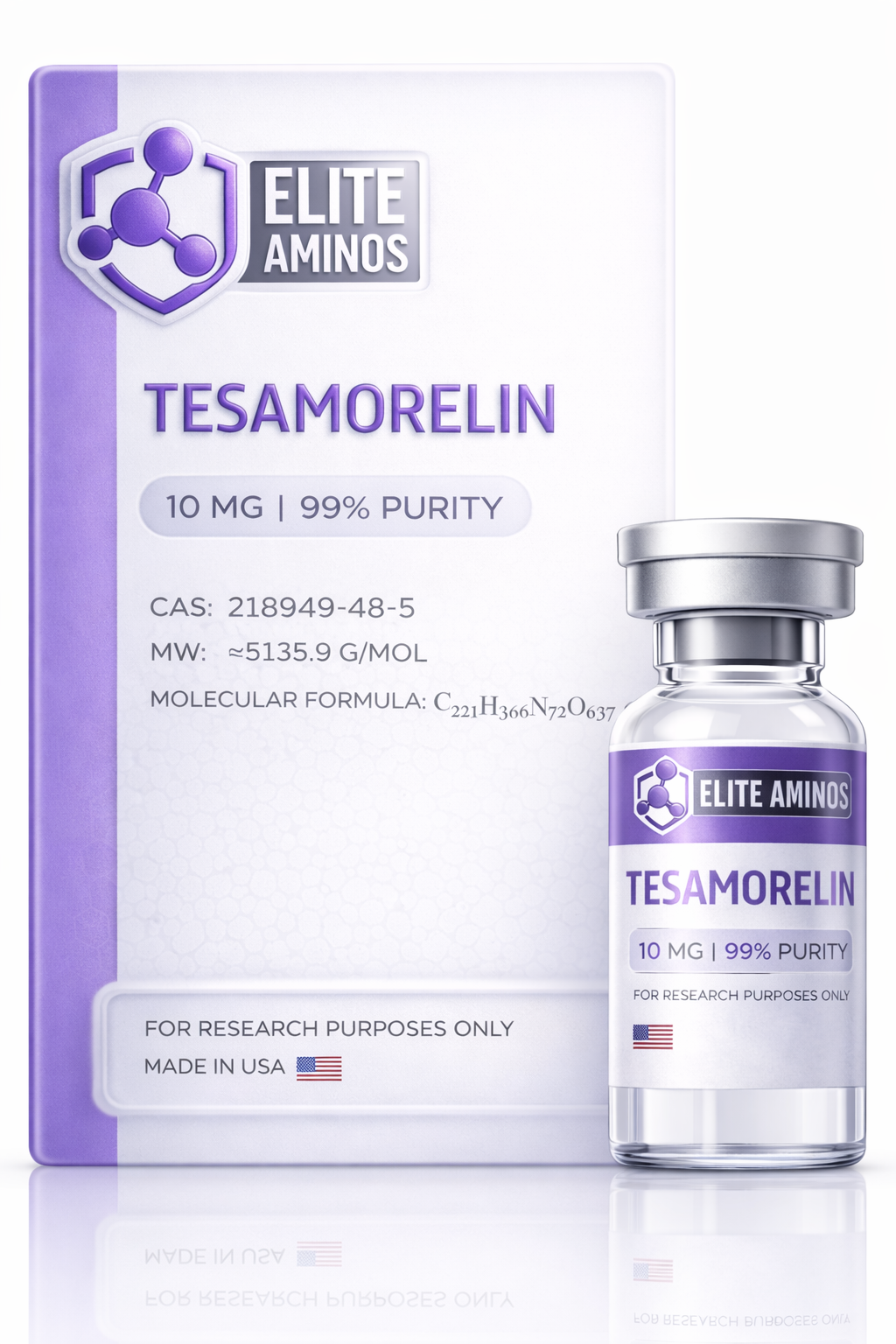
Tesamorelin 10mg Research Peptide
Tesamorelin 10mg is a synthetic research peptide structurally related to growth hormone-releasing hormone (GHRH). It has been studied in laboratory and preclinical settings for its interaction with GHRH receptors located in the anterior pituitary gland, where it may influence signaling pathways associated with growth hormone secretion and downstream insulin-like growth factor-1 (IGF-1) activity. Tesamorelin 10mg is supplied as a lyophilized powder and is intended strictly for laboratory research use.
What Is Tesamorelin 10mg?
Tesamorelin 10mg is a modified analog of human GHRH designed to improve molecular stability and resistance to enzymatic degradation compared to native GHRH. In experimental models, Tesamorelin has been investigated for its ability to stimulate endogenous growth hormone release through receptor-mediated signaling rather than direct hormone administration.
Tesamorelin 10mg is an experimental research compound and is not approved for human or animal use.
Research Background
In research models, growth hormone-releasing hormone interacts with receptors on somatotroph cells in the anterior pituitary gland, initiating intracellular signaling cascades that result in pulsatile growth hormone secretion. Growth hormone is then studied for its downstream effects, including stimulation of IGF-1 production in the liver and peripheral tissues.
Tesamorelin has been examined in preclinical and controlled research environments for its ability to engage these pathways. Experimental data suggests that Tesamorelin may increase overall growth hormone exposure and IGF-1 signaling markers without altering the natural pulsatile pattern of hormone release. These findings remain research observations and are not indicative of clinical outcomes.
Mechanisms of Research Interest
GHRH Receptor Interaction
Tesamorelin 10mg has been studied for its potential to bind to GHRH receptors in the anterior pituitary, possibly inducing conformational changes that initiate intracellular signaling pathways.
cAMP–PKA Signaling Pathway
Research suggests that receptor activation may stimulate adenylate cyclase, increasing intracellular cyclic adenosine monophosphate (cAMP) levels. Elevated cAMP may activate protein kinase A (PKA), a key enzyme involved in signal transduction related to hormone secretion.
Growth Hormone and IGF-1 Research
Experimental findings indicate that Tesamorelin-induced signaling may promote increased secretion of endogenous growth hormone, which in turn has been studied for its role in stimulating systemic and local IGF-1 production. IGF-1 is widely researched for its involvement in anabolic signaling, cellular growth, and survival pathways.
Lipolytic Signaling Research
Growth hormone itself has been examined in research models for its role in lipid metabolism and fat mobilization, particularly in abdominal and visceral adipose tissue. Tesamorelin has been studied in this context as an indirect modulator through endogenous hormone release.
All mechanisms described are theoretical or based on experimental research and do not imply therapeutic benefit.
Structural Modifications and Stability
Tesamorelin differs from native GHRH through specific structural modifications:
-
C-terminus modification: Addition of a trans-3-hexenoic acid group, classified as an omega-amino acid modification, studied for increased resistance to enzymatic degradation
-
N-terminus modification: Acetylation, which may enhance molecular stability and biological activity in research settings
Due to these changes, Tesamorelin is chemically designated as:
N-(trans-3-hexenoyl)-[Tyr1]hGRF(1–44)NH2 acetate
Molecular and Chemical Information
-
Product Name: Tesamorelin 10mg
-
Form: Lyophilized powder
-
Molecular Formula: C221H366N72O67S
-
Molecular Weight: Approximately 5,136 g/mol
-
Alternate Names: (3E)-hex-3-enoylsomatoliberin
Research Applications
Tesamorelin 10mg may be utilized by qualified researchers in laboratory studies involving:
-
GHRH receptor signaling research
-
Growth hormone and IGF-1 pathway analysis
-
cAMP–PKA signal transduction studies
-
Metabolic and endocrine system research models
All use must remain within controlled laboratory environments.
Regulatory Status and Use Disclaimer
-
For research use only
-
Not approved by the Food and Drug Administration
-
Not intended for human or veterinary use
-
Not intended to diagnose, treat, cure, or prevent any disease
-
No established clinical safety, dosing, or efficacy data
| Weight | 0.25 lbs |
|---|---|
| Dimensions | 2.75 × 1.25 × 2.75 in |