
By using this website, you confirm you are 21+ and that all products are for research or laboratory use only—not for human or medical use. You take full responsibility for how you handle and store anything you buy, and the company is not liable for any misuse. If you don’t meet these conditions, you must leave the site.
Your access is restricted because of your age.
$18.00
$125.00
$36.00
1000 in stock
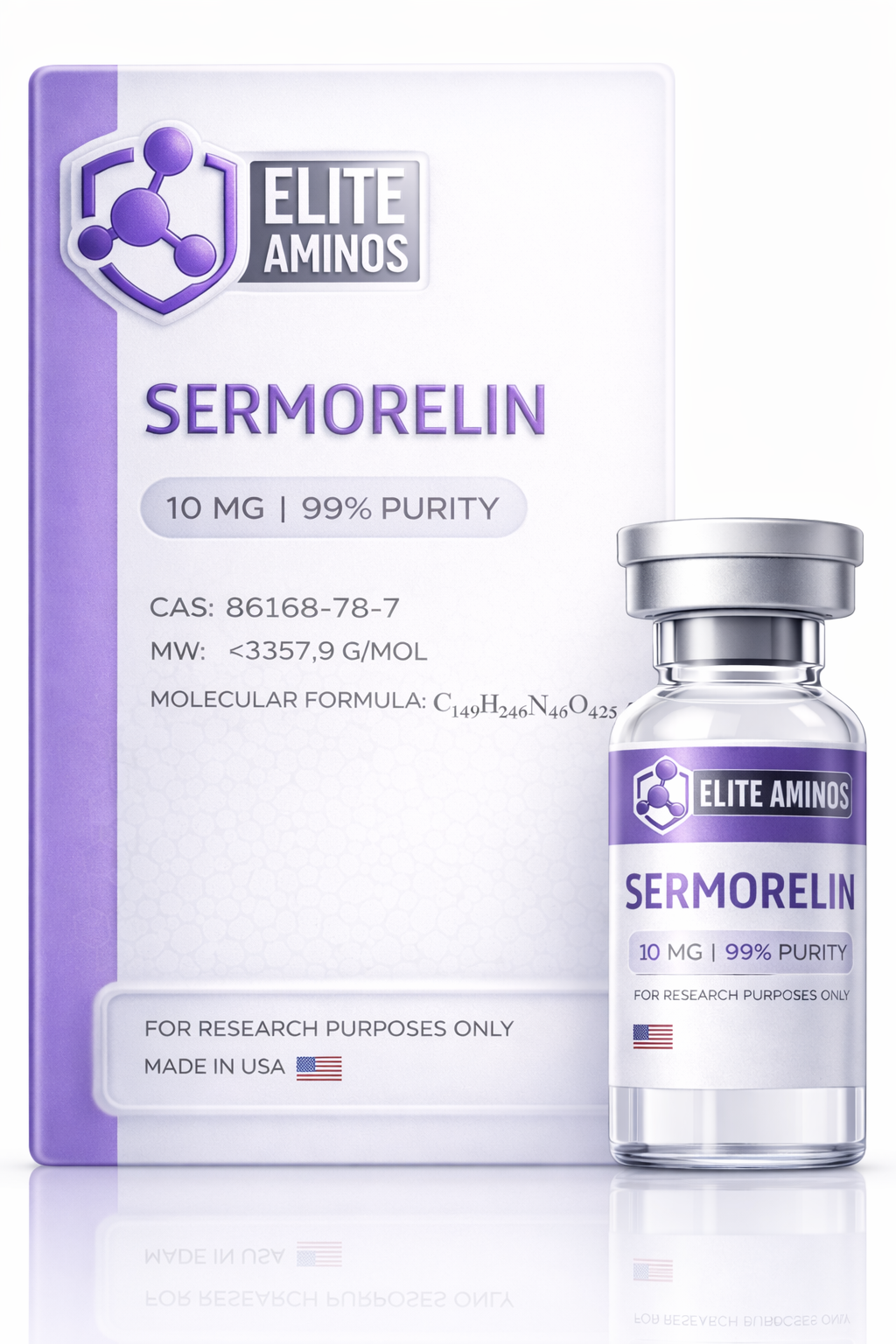
Sermorelin 10mg is a synthetic 29–amino acid research peptide classified as growth hormone–releasing hormone (GHRH 1–29) amide, the shortest biologically active fragment of native GHRH. Supplied as a lyophilized powder with a reported purity greater than 99%, Sermorelin 10mg is studied in laboratory and preclinical settings for its interaction with pituitary signaling pathways related to endogenous growth hormone secretion. This compound is intended strictly for laboratory research use.
Sermorelin 10mg is a truncated analog of human GHRH, designed to retain receptor activity while offering improved stability compared to the full 44–amino acid peptide. First explored in research during the early 1980s, Sermorelin has been used extensively in experimental models examining growth hormone secretagogue mechanisms and endocrine signaling dynamics.
Sermorelin 10mg is an experimental research compound and is not approved for human or animal use.
Native growth hormone–releasing hormone stimulates the anterior pituitary gland to release pulsatile growth hormone, which subsequently influences downstream pathways including insulin-like growth factor 1 (IGF-1) production. By isolating the first 29 amino acids of GHRH, researchers created Sermorelin to maintain receptor binding while simplifying molecular structure.
Animal and in vitro studies have shown that Sermorelin can activate pituitary somatotroph cells, leading to increased growth hormone release and secondary IGF-1 signaling. These findings remain preclinical and have not been validated in human clinical trials.
Sermorelin 10mg has been studied for its ability to bind to GHRH receptors on pituitary somatotroph cells, initiating intracellular signaling pathways associated with growth hormone secretion.
Unlike direct administration of growth hormone in experimental models, Sermorelin has been examined for its ability to support endogenous, rhythmic growth hormone release, preserving natural endocrine signaling patterns.
Growth hormone release stimulated by Sermorelin has been studied for its downstream effect on IGF-1 production, a key mediator involved in anabolic and growth-related signaling pathways.
Research observations suggest Sermorelin does not significantly alter other hormonal systems, including prolactin, insulin, cortisol, glucose, or thyroid hormone levels, making it a compound of interest in selective endocrine signaling studies.
All mechanisms described are experimental observations only and do not imply therapeutic benefit.
Product Name: Sermorelin 10mg
Form: Lyophilized powder
Purity: Greater than 99%
Peptide Length: 29 amino acids
Classification: GHRH (1–29) amide
Estimated Half-Life: Approximately 11–12 minutes
Alternate Names: GHRH (1–29) amide, GHRF (1–29)
Sermorelin 10mg may be utilized by qualified researchers in laboratory investigations involving:
Growth hormone–releasing hormone receptor signaling
Endocrine pathway and pituitary function research
IGF-1 and anabolic signaling studies
Pulsatile hormone secretion modeling
All use must remain within controlled laboratory environments.
For research use only
Not approved by the Food and Drug Administration
Not intended for human or veterinary use
Not intended to diagnose, treat, cure, or prevent any disease
No established clinical safety, dosing, or efficacy data
| Weight | 0.25 lbs |
|---|---|
| Dimensions | 2.75 × 1.25 × 2.75 in |