
By using this website, you confirm you are 21+ and that all products are for research or laboratory use only—not for human or medical use. You take full responsibility for how you handle and store anything you buy, and the company is not liable for any misuse. If you don’t meet these conditions, you must leave the site.
Your access is restricted because of your age.
$77.00
$95.00
$75.00
1000 in stock
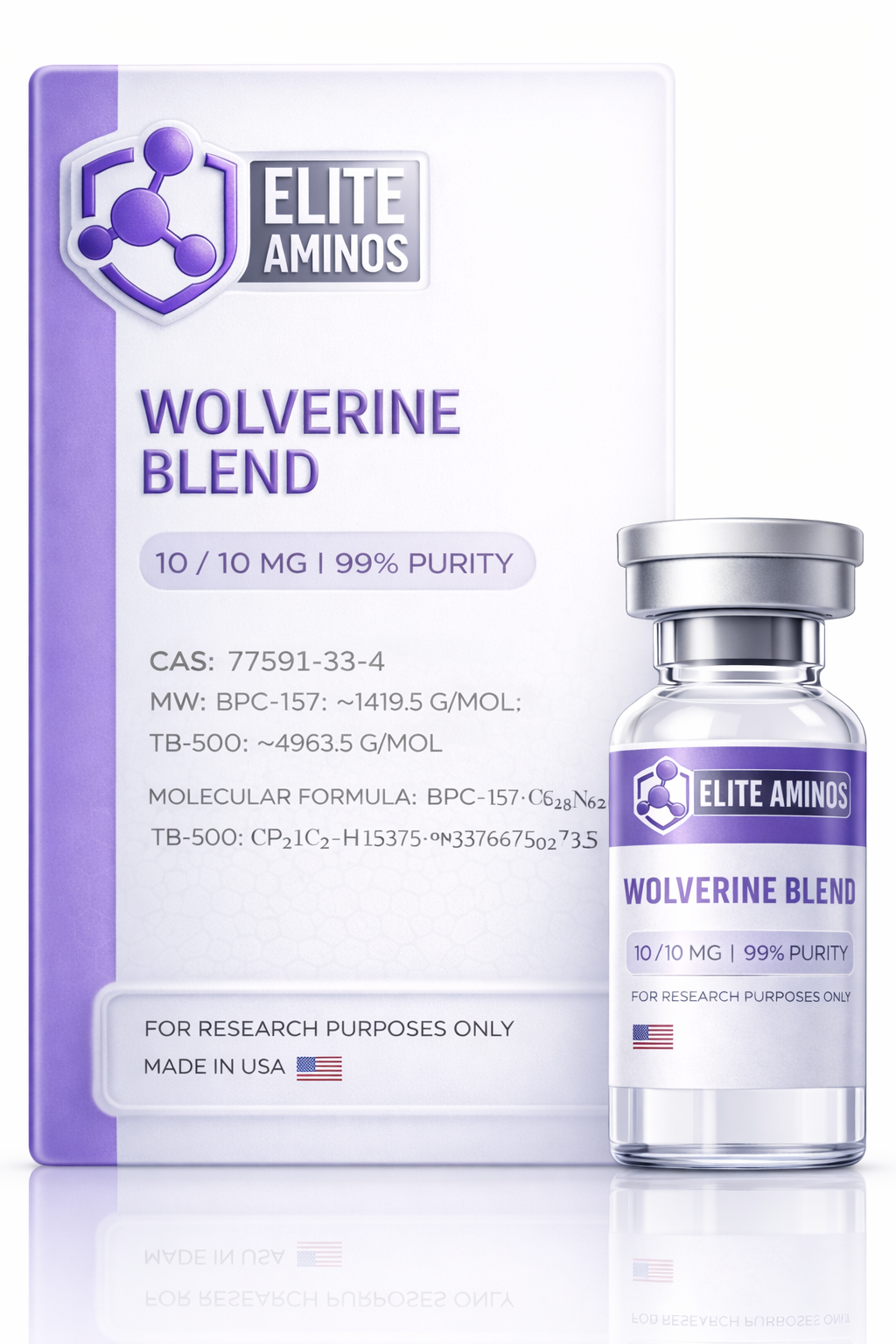
Wolverine Stack – BPC-157 10mg + TB-500 10mg is an informal research bundle combining two well-documented synthetic peptides that are frequently studied together in laboratory settings focused on tissue integrity, cellular signaling, and injury-response pathways. This stack pairs BPC-157, a peptide fragment derived from body protection compound proteins, with TB-500, a synthetic version of the active region of thymosin beta-4.
The Wolverine Stack is supplied strictly for research and laboratory investigation and is not approved for human or animal use.
The Wolverine Stack refers to the combined study of BPC-157 5mg and TB-500 10mg in experimental research models. Researchers often explore this pairing because each peptide has been independently studied for its involvement in:
Cellular migration pathways
Cytoskeletal organization
Angiogenic signaling processes
Tissue response following mechanical or inflammatory stress
While the name “Wolverine Stack” is informal, the peptides themselves are well-established in preclinical research literature.
BPC-157 is a synthetic pentadecapeptide derived from a naturally occurring body protection compound. In animal and in vitro studies, BPC-157 has been investigated for its interaction with:
Nitric oxide signaling pathways
Growth factor modulation
Fibroblast activity
Tendon-to-bone interface signaling
Research models have examined BPC-157 in the context of soft tissue structures such as tendons, ligaments, muscle tissue, and the gastrointestinal system. These findings are preclinical only and have not been validated in human clinical trials.
TB-500 is a synthetic peptide corresponding to a functional region of thymosin beta-4. In laboratory studies, TB-500 has been examined for its role in:
Actin-binding and cytoskeletal remodeling
Cellular migration
Angiogenesis-related signaling
Tissue organization following injury models
TB-500 is frequently studied in animal research involving musculoskeletal and connective tissue systems. Like BPC-157, TB-500 remains experimental and is not approved for therapeutic use.
Researchers sometimes explore the Wolverine Stack – BPC-157 10mg + TB-500 10mg because the peptides act on distinct but potentially complementary biological pathways:
BPC-157 is often studied for localized signaling and tissue-specific responses
TB-500 is commonly examined for systemic cellular migration and structural organization
Studying these peptides together allows investigators to observe how multiple signaling mechanisms may interact within controlled experimental environments. No conclusions regarding safety, effectiveness, or outcomes in humans can be drawn from these studies.
Supplied for laboratory research use only
Not approved by the Food and Drug Administration for human or veterinary use
Not intended to diagnose, treat, cure, or prevent any disease
No clinical safety or efficacy data established in humans
Use limited to qualified research professionals
Informal research bundle: Wolverine Stack
Includes: BPC-157 10mg and TB-500 10mg
Synthetic research peptides
Intended exclusively for scientific investigation
| Weight | 0.25 lbs |
|---|---|
| Dimensions | 2.75 × 1.25 × 2.75 in |