
By using this website, you confirm you are 21+ and that all products are for research or laboratory use only—not for human or medical use. You take full responsibility for how you handle and store anything you buy, and the company is not liable for any misuse. If you don’t meet these conditions, you must leave the site.
Your access is restricted because of your age.
$125.00
$18.00
$210.00
1000 in stock
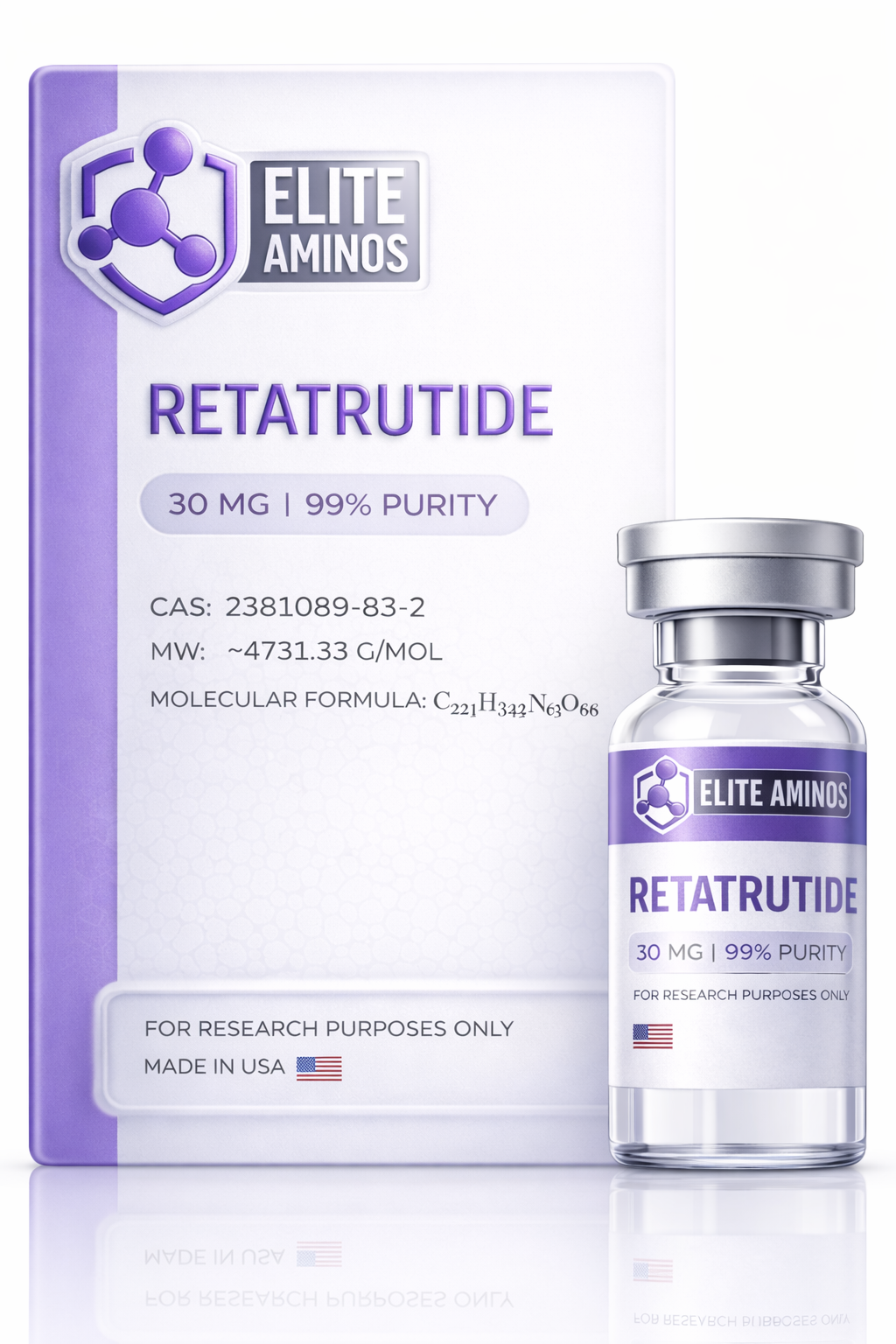
Retatrutide 30mg is a synthetic triple receptor agonist research compound studied in laboratory and preclinical settings for its interaction with glucagon-like peptide-1 receptors, glucose-dependent insulinotropic polypeptide receptors, and glucagon receptors. This unique multi-receptor profile makes Retatrutide 30mg a compound of interest in experimental research focused on metabolic signaling, energy regulation pathways, and appetite-related receptor activity. Retatrutide 30mg is supplied strictly for laboratory research use.
Retatrutide 30mg is an experimental peptide-based compound designed to engage three distinct hormonal receptor systems involved in metabolic and energy balance signaling. Unlike single- or dual-agonist compounds, Retatrutide is studied for its ability to simultaneously activate multiple incretin and glucagon-related pathways in controlled research environments.
Retatrutide 30mg is an experimental research compound and is not approved for human or animal use.
Glucagon-like peptide-1, glucose-dependent insulinotropic polypeptide, and glucagon receptors each play roles in glucose metabolism, appetite signaling, and energy expenditure in biological systems. Research involving multi-agonist compounds focuses on understanding how coordinated activation of these receptors may influence complex metabolic signaling networks.
In laboratory and animal studies, triple-agonist compounds such as Retatrutide have been examined for their ability to modulate metabolic efficiency, insulin-related signaling pathways, and appetite-associated neural circuits. All findings related to Retatrutide remain preclinical and have not been validated through human clinical trials.
Retatrutide 30mg has been studied for its ability to activate GLP-1, GIP, and glucagon receptors, allowing researchers to observe how simultaneous receptor engagement influences downstream metabolic signaling pathways.
Experimental models investigate how triple agonism may affect glucose utilization, insulin sensitivity markers, and systemic energy balance under controlled laboratory conditions.
GLP-1 and GIP receptors are expressed in both peripheral tissues and central nervous system regions associated with appetite signaling. Retatrutide is studied to explore how multi-receptor activation may influence appetite-related pathways in experimental models.
Glucagon receptor activation has been examined in research models for its involvement in energy mobilization and lipid metabolism signaling, making Retatrutide a compound of interest in comprehensive metabolic pathway research.
All mechanisms described are experimental or theoretical and do not imply clinical or therapeutic outcomes.
Product Name: Retatrutide 30mg
Form: Lyophilized powder
Purity: Research-grade (greater than 99%)
Classification: Triple receptor agonist (GLP-1 / GIP / glucagon) research compound
Retatrutide 30mg may be utilized by qualified researchers in laboratory investigations involving:
Multi-receptor metabolic signaling studies
GLP-1, GIP, and glucagon pathway research
Appetite and energy balance signaling models
Advanced metabolic and endocrine research
All use must remain within controlled laboratory environments.
For research use only
Not approved by the Food and Drug Administration
Not intended for human or veterinary use
Not intended to diagnose, treat, cure, or prevent any disease
No established clinical safety, dosing, or efficacy data
| Weight | 0.25 lbs |
|---|---|
| Dimensions | 2.75 × 1.25 × 2.75 in |