
By using this website, you confirm you are 21+ and that all products are for research or laboratory use only—not for human or medical use. You take full responsibility for how you handle and store anything you buy, and the company is not liable for any misuse. If you don’t meet these conditions, you must leave the site.
Your access is restricted because of your age.
$48.00
$18.00
$50.00
1000 in stock
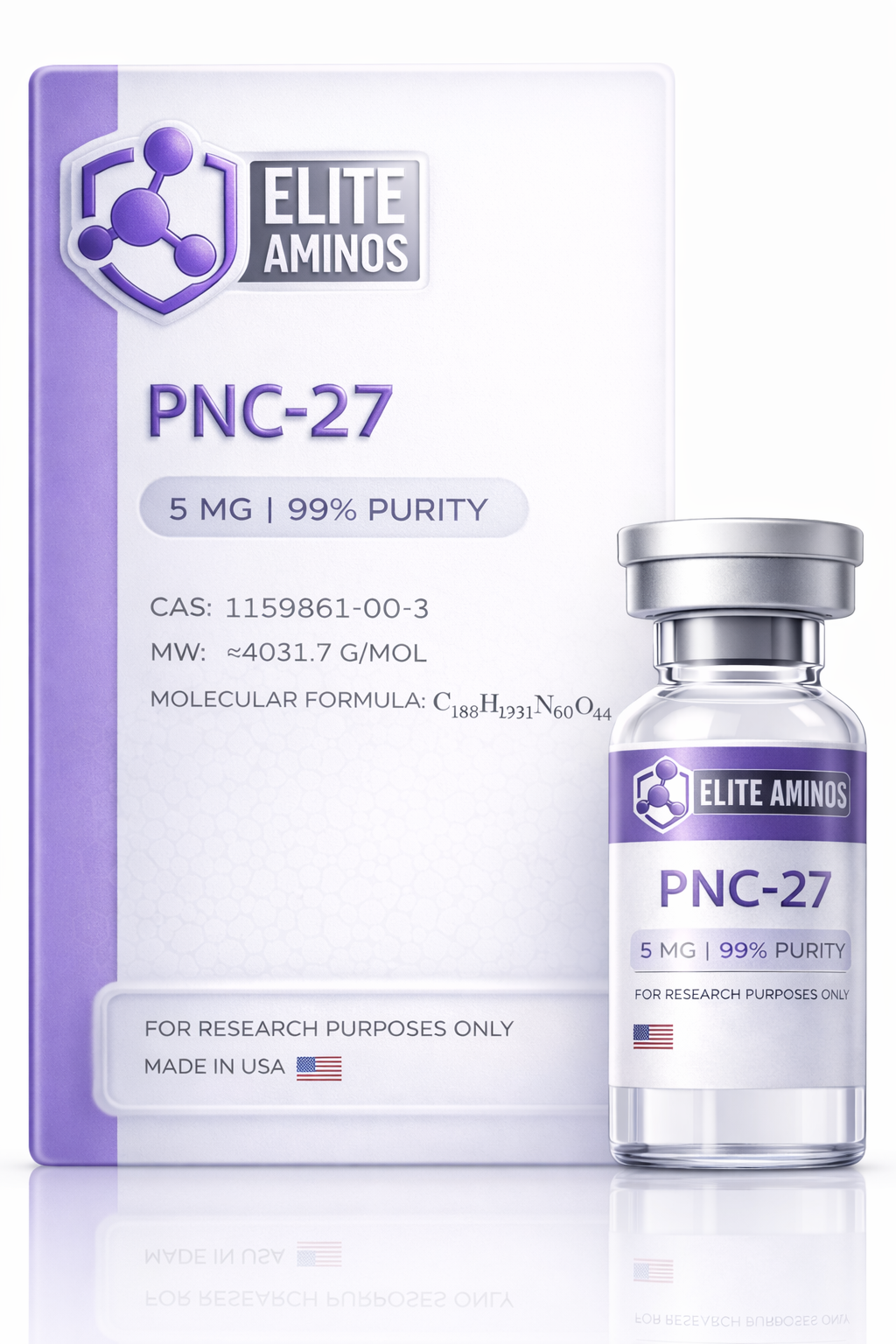
PNC-27 5mg is a synthetic 27–amino acid research peptide derived from the third alpha-helical segment of the tumor suppressor protein p53 (ASPP2 region). It has been studied in laboratory and preclinical models for its potential ability to selectively interact with cancer cell membranes through binding to human double minute 2 (HDM-2) protein. PNC-27 5mg is supplied strictly for laboratory research use and is not approved for human or animal use.
PNC-27 5mg is an experimental peptide originally synthesized around the year 2000 during research related to immunodeficiency studies. Subsequent investigations identified its potential interaction with HDM-2, a protein reported to be overexpressed on the plasma membranes of various cancer cell types. Unlike many anticancer research compounds that induce apoptosis, PNC-27 has been examined for its ability to induce necrotic cell death through direct membrane disruption in experimental models.
PNC-27 5mg remains an experimental research peptide used exclusively in controlled scientific environments.
Research into PNC-27 has focused on its selective activity toward cancer cells observed in laboratory studies. HDM-2 protein has been reported to localize on the membranes of certain cancer cells but not on normal, non-transformed cells. This distinction led researchers to investigate whether PNC-27 could selectively bind cancer cell membranes while sparing normal cells.
Multiple in vitro and animal studies have examined PNC-27 in cancer cell lines including pancreatic cancer, ovarian cancer, leukemia, and breast tumor models. These findings are preclinical and have not been validated in human clinical trials.
PNC-27 5mg has been studied for its ability to form a 1:1 complex with membrane-bound HDM-2, a step proposed to be critical for initiating downstream membrane-disruptive events in cancer cells.
Experimental observations suggest that PNC-27 may participate in the formation of transmembrane pores, resulting in physical perforation of cancer cell membranes. This process has been associated with membranolysis, allowing ion influx and efflux of intracellular contents in research models.
Unlike apoptosis-inducing compounds, PNC-27 has been examined for its ability to induce necrosis. Laboratory studies associate this mechanism with lactate dehydrogenase release, a marker of membrane disruption and cell lysis.
Fluorescent labeling studies indicate that intact PNC-27 is required for membrane-disruptive activity. Research suggests that peptide fragments do not produce the same membranolytic effects, underscoring the importance of structural integrity.
Immuno-electron microscopy studies have visualized ring-shaped pore structures on cancer cell membranes exposed to PNC-27. These structures were not observed in normal cells unless HDM-2 protein was artificially introduced, supporting research hypotheses of selective activity.
All mechanisms described are experimental observations or theoretical models and do not imply clinical or therapeutic benefit.
Product Name: PNC-27 5mg
Peptide Length: 27 amino acids
Origin: p53 (ASPP2) alpha-helical segment
Form: Lyophilized powder
Purity: Research-grade (greater than 99%)
PNC-27 5mg may be utilized by qualified researchers in laboratory investigations involving:
Cancer cell membrane biology research
HDM-2 protein interaction studies
Necrotic cell death pathway research
Membrane pore formation and cytolysis models
All use must remain within controlled laboratory environments.
For research use only
Not approved by the Food and Drug Administration
Not intended for human or veterinary use
Not intended to diagnose, treat, cure, or prevent any disease
No established clinical safety, dosing, or efficacy data
| Weight | 0.25 lbs |
|---|---|
| Dimensions | 2.75 × 1.25 × 2.75 in |