
By using this website, you confirm you are 21+ and that all products are for research or laboratory use only—not for human or medical use. You take full responsibility for how you handle and store anything you buy, and the company is not liable for any misuse. If you don’t meet these conditions, you must leave the site.
Your access is restricted because of your age.
$35.00
$77.00
$45.00
1000 in stock
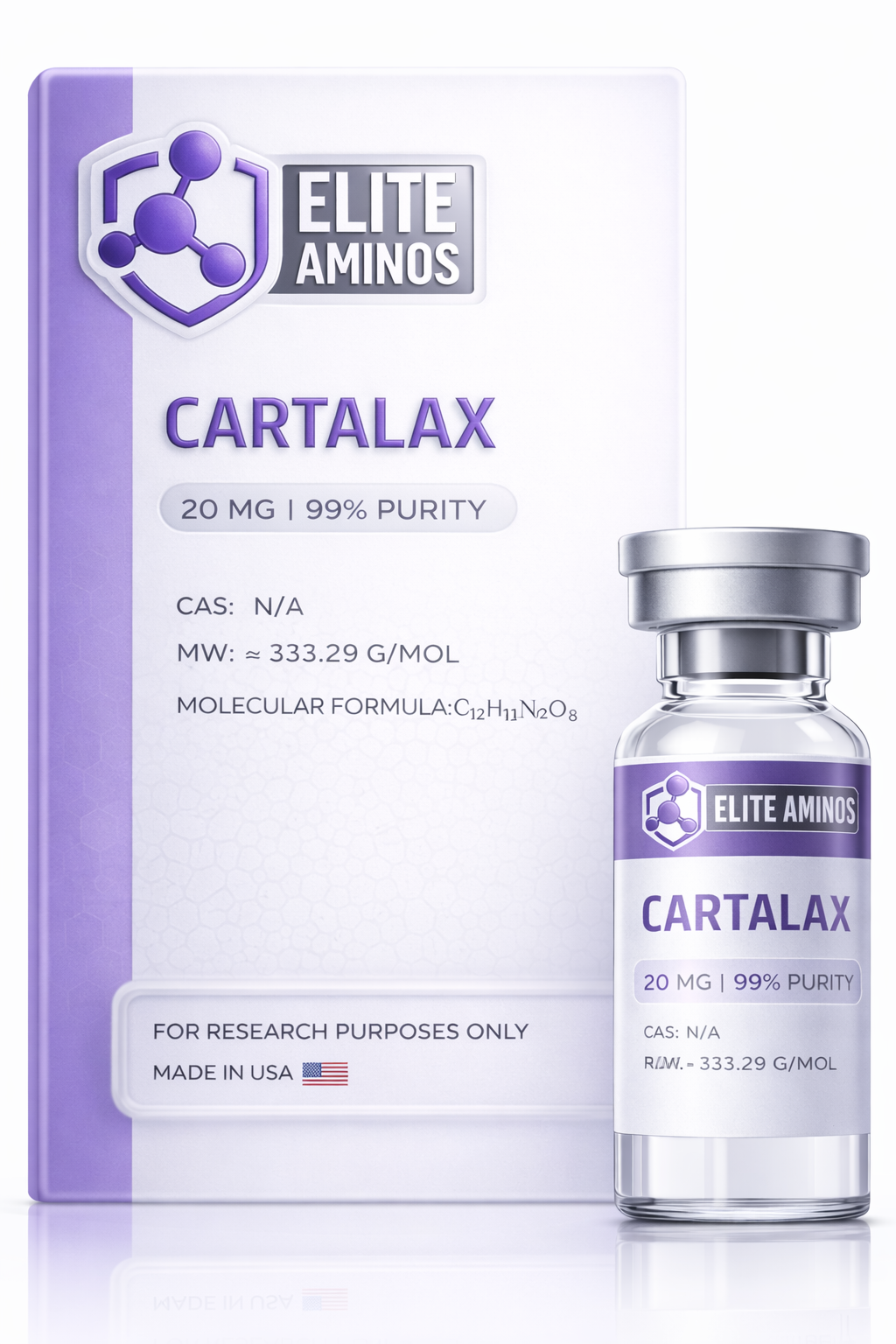
Cartalax 20mg is a synthetic research peptide classified among the Khavinson peptides, a group of short peptides studied for their potential role in cellular regulation and tissue-specific signaling. Cartalax 20mg is derived from the amino acid sequence Alanine–Glutamate–Aspartate, corresponding to a fragment of the alpha-1 chain of type XI collagen. It is supplied as a lyophilized powder with a reported purity greater than 99%, intended exclusively for laboratory research applications.
Cartalax, also known as AED peptide or T-31 peptide, is a short synthetic tripeptide originally identified in kidney-derived polypeptide extracts and later synthesized for research purposes. Within experimental settings, Cartalax 20mg has been investigated as a bioregulatory peptide, with research interest centered on cellular aging markers, connective tissue signaling, and cartilage-associated biological processes.
Cartalax 20mg is not approved for human or animal use and remains an experimental compound.
Research into Cartalax 20mg has focused on its potential involvement in biological processes associated with:
Fibroblast proliferation models
Cellular lifespan and senescence markers
Tissue regeneration signaling pathways
Inflammatory response modulation in preclinical models
Studies exploring Khavinson peptides often examine their ability to influence gene expression and cellular activity in a tissue-specific manner. Findings related to Cartalax are limited to in vitro and animal research and have not been validated in clinical trials.
Within laboratory studies, Cartalax 20mg has been examined for its potential influence on several cellular markers and processes:
Research suggests Cartalax may be associated with increased expression of Ki-67, a marker commonly used to assess cellular division and proliferation in fibroblast models.
Cartalax has been studied for its possible relationship with CD98hc expression, a protein involved in cellular vitality and regenerative signaling pathways.
Experimental findings have explored whether Cartalax may influence apoptotic signaling, including potential modulation of caspase-3 activity, a key enzyme involved in programmed cell death.
Cartalax 20mg has been investigated in research models related to cartilage biology and connective tissue signaling, particularly in studies examining osteoarthritis-associated cellular markers.
These mechanisms remain theoretical and experimental and should not be interpreted as established biological outcomes.
Product Name: Cartalax 20mg
Form: Lyophilized powder
Purity: Greater than 99%
Molecular Formula: C12H19N3O8
Molecular Weight: 333.29 g/mol
Amino Acid Sequence: Alanine–Glutamate–Aspartate
Alternate Names: AED, T-31, SCHEMBL5324601
Cartalax 20mg may be utilized by qualified researchers in laboratory studies involving:
Cellular aging and senescence models
Fibroblast lifespan research
Connective tissue and cartilage biology
Bioregulatory peptide investigations
All applications must remain within controlled research environments.
For research use only
Not approved by the Food and Drug Administration
Not intended for human or veterinary use
Not intended to diagnose, treat, cure, or prevent any disease
No established clinical safety or efficacy data
| Weight | 0.25 lbs |
|---|---|
| Dimensions | 2.75 × 1.25 × 2.75 in |