
By using this website, you confirm you are 21+ and that all products are for research or laboratory use only—not for human or medical use. You take full responsibility for how you handle and store anything you buy, and the company is not liable for any misuse. If you don’t meet these conditions, you must leave the site.
Your access is restricted because of your age.
$28.00
$48.00
$80.00
1000 in stock
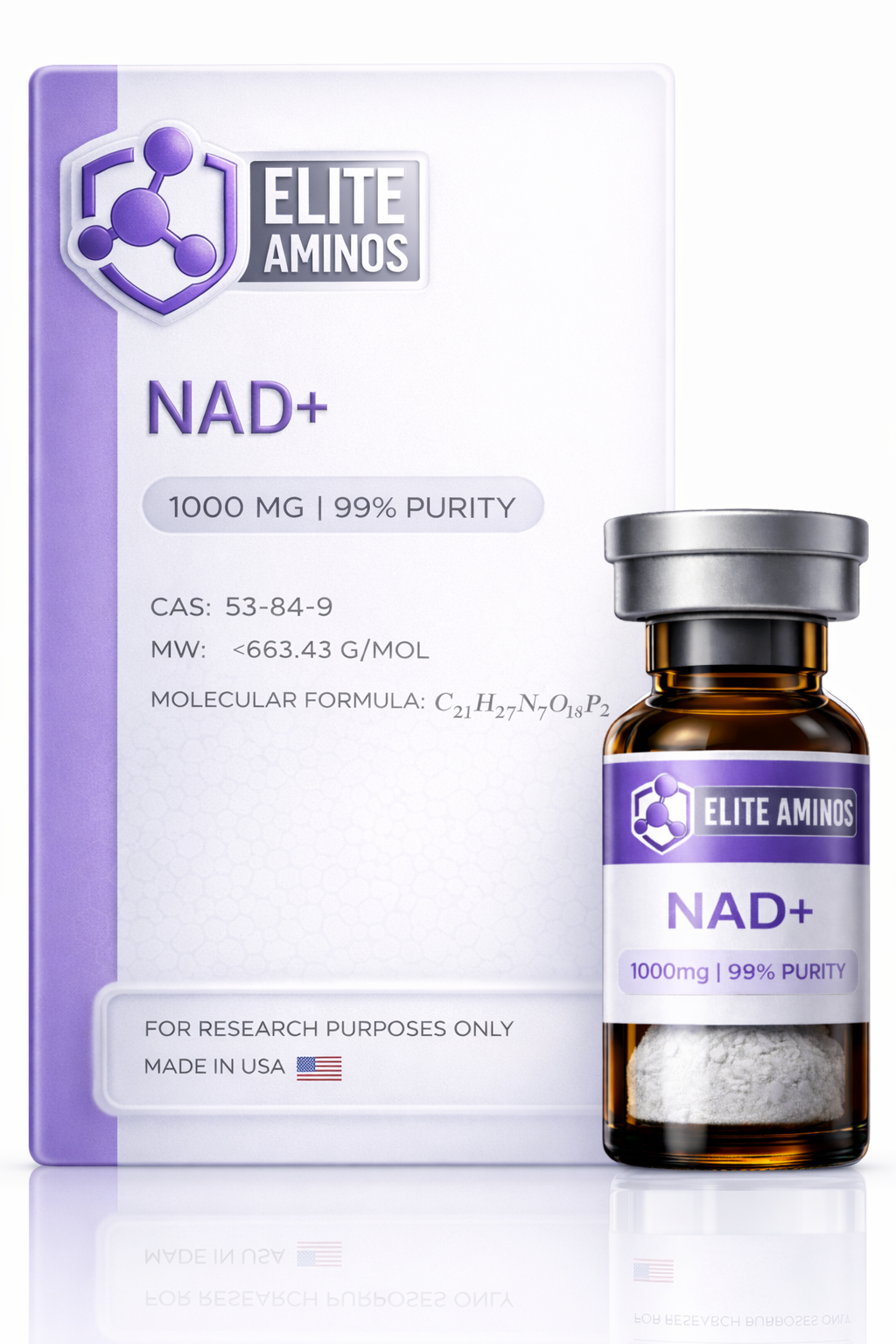
NAD+ 1000mg (nicotinamide adenine dinucleotide) is a high-concentration research-grade biochemical compound studied extensively in laboratory and preclinical environments for its role in cellular energy metabolism, mitochondrial function, and redox signaling pathways. NAD+ 1000mg is supplied exclusively for laboratory research use and is not approved for human or animal administration.
NAD+ is a naturally occurring coenzyme found in all living cells and is essential for numerous metabolic and signaling processes. In research settings, NAD+ is studied for its involvement in electron transfer reactions, oxidative phosphorylation, and cellular repair mechanisms.
NAD+ exists in two primary forms: oxidized (NAD+) and reduced (NADH). The balance between these forms is critical for maintaining cellular energy production and metabolic homeostasis in experimental models.
NAD+ 1000mg is an experimental research compound intended for controlled scientific investigation.
NAD+ plays a central role in glycolysis, the tricarboxylic acid cycle, and the electron transport chain, making it foundational to cellular energy production. Beyond metabolism, NAD+ serves as a substrate for several enzyme families, including sirtuins, poly(ADP-ribose) polymerases, and CD38, which are studied for their roles in DNA repair, stress response, and cellular signaling.
Research indicates that intracellular NAD+ levels may decline with age and under metabolic stress, prompting extensive investigation into NAD+ metabolism, biosynthesis pathways, and cellular utilization. All findings remain preclinical unless otherwise validated.
NAD+ 1000mg is studied for its role as an electron carrier in redox reactions essential to ATP production and mitochondrial respiration research.
NAD+ availability is examined for its influence on mitochondrial efficiency, oxidative phosphorylation, and metabolic flexibility in laboratory models.
NAD+ serves as a required cofactor for sirtuin enzymes, which are studied for their involvement in gene regulation, stress resistance, and metabolic signaling pathways.
Poly(ADP-ribose) polymerases utilize NAD+ as a substrate during DNA damage response signaling, making NAD+ central to genomic stability research.
All mechanisms described are biochemical research observations and do not imply therapeutic benefit.
Product Name: NAD+ 1000mg
Chemical Name: Nicotinamide adenine dinucleotide
Form: Research-grade compound
Classification: Cellular coenzyme
Molecular Formula: C21H27N7O14P2
Molecular Weight: 663.43 g/mol
NAD+ 1000mg may be utilized by qualified researchers in laboratory investigations involving:
Cellular energy metabolism studies
Mitochondrial function and redox signaling research
Sirtuin and enzyme pathway analysis
Aging-related metabolic and cellular stress models
All use must remain within controlled laboratory environments.
For research use only
Not approved by the Food and Drug Administration
Not intended for human or veterinary use
Not intended to diagnose, treat, cure, or prevent any disease
No established clinical safety, dosing, or efficacy data
| Weight | 0.25 lbs |
|---|---|
| Dimensions | 2.75 × 1.25 × 2.75 in |