
By using this website, you confirm you are 21+ and that all products are for research or laboratory use only—not for human or medical use. You take full responsibility for how you handle and store anything you buy, and the company is not liable for any misuse. If you don’t meet these conditions, you must leave the site.
Your access is restricted because of your age.
$41.00
$42.00
$18.00
1000 in stock
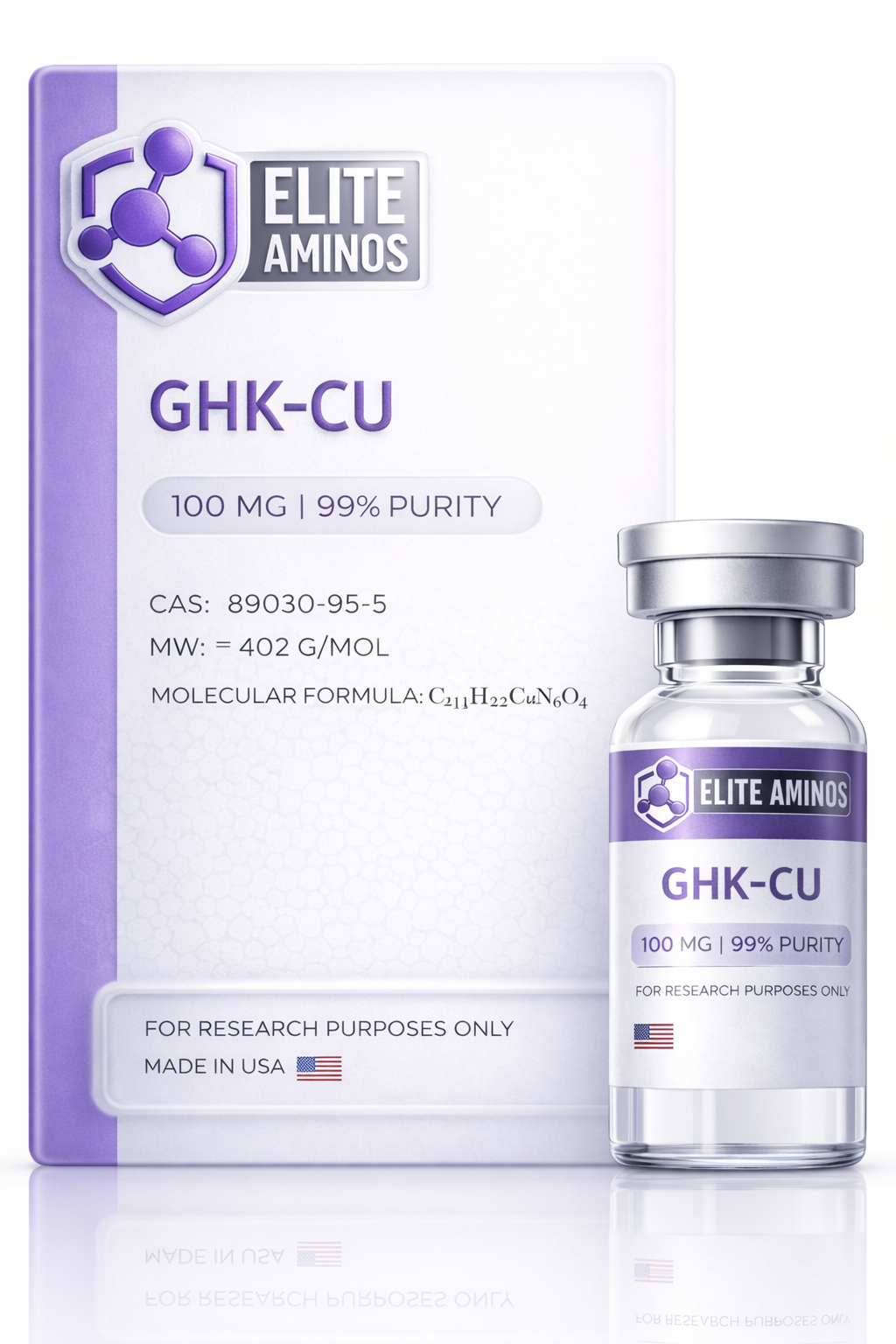
GHK-Cu 100mg is a naturally occurring copper-binding tripeptide research compound composed of glycyl–L-histidyl–L-lysine complexed with copper ions. This peptide–metal complex is present in human plasma and has been studied extensively in laboratory and preclinical environments for its involvement in tissue repair signaling, extracellular matrix regulation, and cellular gene expression pathways. Supplied as a lyophilized powder with a reported purity greater than 99%, GHK-Cu 100mg is intended exclusively for laboratory research use.
GHK-Cu 100mg is the copper-complexed form of the GHK peptide. The copper ion is considered critical for biological activity in research models, as GHK exhibits enhanced signaling properties when bound to copper or trace metals. GHK-Cu is released endogenously following tissue injury and has been investigated for its role in cellular repair and regeneration pathways.
Research indicates that endogenous GHK-Cu levels decline with age, prompting extensive investigation into its involvement in aging-related cellular changes and tissue maintenance. GHK-Cu 100mg is an experimental research compound and is not approved for human or animal use.
Cell culture studies have shown that nanomolar concentrations of GHK-Cu can induce diverse cellular responses, including effects on growth, differentiation, and structural protein synthesis. GHK-Cu also demonstrates metal chelation properties, binding copper ions and small amounts of iron, which may enhance its biological signaling capacity in experimental systems.
Research has further examined GHK-Cu for its potential involvement in gene expression modulation, with some findings suggesting it may influence transcriptional programs associated with tissue repair, inflammation control, and cellular resilience. These findings remain preclinical and have not been validated in human clinical trials.
GHK-Cu 100mg has been studied for its influence on pathways involved in collagen synthesis, elastin organization, and extracellular matrix maintenance, making it a compound of interest in skin structure research models.
Experimental studies have examined GHK-Cu for its potential role in tissue regeneration signaling, inflammation modulation, and cellular migration processes following injury.
GHK-Cu has been investigated in laboratory settings for its potential influence on hair follicle size, activity, and growth-cycle signaling pathways.
Research suggests GHK-Cu may participate in oxidative stress mitigation, possibly through metal chelation and redox-related biochemical pathways.
Some experimental findings indicate GHK-Cu may influence large sets of genes, with research interest in its potential ability to shift gene expression toward patterns associated with healthier cellular function.
All mechanisms described are experimental observations or theoretical models and do not imply clinical, cosmetic, or therapeutic benefit.
Product Name: GHK-Cu 100mg
Form: Lyophilized powder
Purity: Greater than 99%
Peptide Type: Copper-binding tripeptide
Amino Acid Sequence: Glycyl–L-histidyl–L-lysine
Molecular Formula: C14H23CuN6O4
Molecular Weight: 340.38 g/mol
Alternate Names: Glycyl–L-histidyl–L-lysine–copper (2+)
GHK-Cu 100mg may be utilized by qualified researchers in laboratory investigations involving:
Tissue repair and regeneration signaling studies
Extracellular matrix and collagen research
Gene expression and cellular aging models
Oxidative stress and antioxidant pathway research
All use must remain within controlled laboratory environments.
For research use only
Not approved by the Food and Drug Administration
Not intended for human or veterinary use
Not intended to diagnose, treat, cure, prevent, or alter any disease or condition
No established clinical safety, dosing, or efficacy data
| Weight | 0.25 lbs |
|---|---|
| Dimensions | 2.75 × 1.25 × 2.75 in |